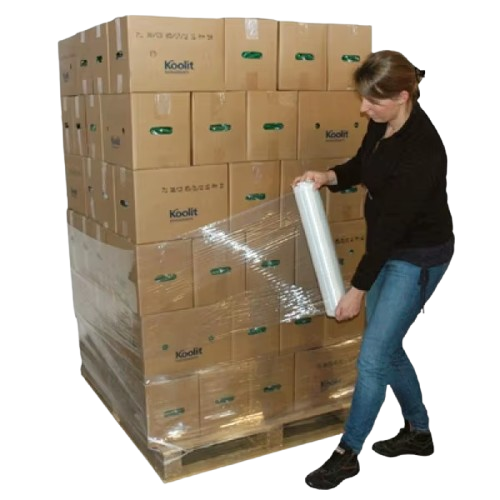
Case Study: Load Containment
When Hand Wrapping Pallets Becomes a Hidden Cost
Hand stretch wrapping is common, familiar, and flexible. As pallet volumes increase, it often becomes one of the most inefficient and inconsistent steps in shipping operations.
At Kyana Packaging Solutions, we evaluate pallet wrapping operations through the Kyana Packaging Assessment (KPA). For many customers, the KPA reveals that transitioning from hand wrap to a stretch wrapper is not primarily about automation, it’s about load integrity, labor efficiency, safety, and film optimization.
As part of the KPA, we assess whether automatic or semi‑automatic stretch wrappers from Highlight Industries are the right solution based on throughput, risk, and total cost.
Common Challenges with Hand Stretch Wrapping
We frequently see the following issues in hand‑wrapped operations:
- Inconsistent wrap force from pallet to pallet
- Excessive film usage to “feel safe”
- Load failures during LTL or mixed freight transit
- Bottom‑layer carton compression
- Operator fatigue and ergonomic risk
- Dependence on individual technique rather than standard process
Hand wrapping works but it is operator‑dependent, difficult to standardize, and increasingly costly at scale.
1. Pallet Volume & Throughput Analysis
The KPA evaluates:
- Pallets wrapped per shift
- Wrap time per pallet
- Congestion at shipping lanes
- Peak vs average demand
Common Finding:
Operations wrapping dozens of pallets per shift often reach a point where hand wrap limits throughput and consistency.
2. Labor Cost, Safety & Utilization Review
The KPA examines:
- Fully loaded labor cost per pallet
- Repetitive motion and fatigue risk
- Variability between operators
- Opportunity to redeploy labor
Common finding:
Hand wrapping consumes labor while introducing ergonomic risk and does not scale without adding more people.
3. Load Containment Consistency & Failure Risk
Containment force matters more than appearance.
The KPA assesses:
- Actual film force applied
- Variability between pallets
- Film over‑stretching or under‑stretching
- Load shift and corner bulge patterns
Key issue with hand wrap:
It cannot consistently apply repeatable containment force, especially on tall or heavy loads.
4. Film Usage & Cost per Pallet
Hand wrapping often hides film waste.
The KPA evaluates:
- Film consumption per pallet
- Gauge vs actual performance
- Roping and neck‑down effects
- Yield inconsistency
Automation advantage:
Stretch wrappers pre‑stretch film consistently, often reducing film usage while improving load stability.
5. Standardization & Risk Reduction
The KPA evaluates:
- Customer damage claims tied to load failure
- Internal rewrap or restacking events
- Carrier compliance concerns
Where Highlight Industries Stretch Wrappers Fit Within the KPA
When the KPA indicates that hand wrap is limiting performance, Highlight Industries stretch wrappers are often evaluated due to their focus on:
- Consistent containment force
- Controlled pre‑stretch
- Operator‑independent results
- Scalable throughput
- Industrial reliability
Highlight stretch wrappers support:
- Improved load stability
- Reduced film consumption
- Faster, safer pallet wrapping
- Repeatable standards across shifts
Importantly, the KPA determines whether automation is appropriate. Equipment follows the need, not the other way around.
Building the Business Case: Hand Wrap vs Stretch Wrapper
Through the KPA, we quantify:
- Labor time per pallet
- Film cost per pallet
- Load failure risk
- Throughput constraints
- Safety and ergonomic exposure
For many operations, stretch wrappers:
- Reduce film usage despite higher performance
- Improve load integrity in transit
- Pay back in months when labor and film savings are included
- Reduce damage, rework, and variability
Typical KPA Findings
Distributor – High LTL Volume
- KPA Finding: Load failures traced to inconsistent wrap force
- Recommendation: Stretch wrapper with standardized wrap profiles
- Outcome: Improved load integrity and fewer delivery exceptions
Manufacturer – Multiple Shifts
- KPA Finding: Hand wrap technique varied widely by operator
- Recommendation: Highlight stretch wrapper with preset programs
- Outcome: Consistent wrapping across shifts with lower film usage
What Not to Do When Hand Wrap Falls Short
❌ Add more wraps without measuring force
❌ Use heavier film to compensate for inconsistency
❌ Assume pallet failures are only handling‑related
❌ Ignore ergonomic and injury risk
❌ Delay automation until damage costs escalate
These steps increase cost while masking the root cause.
Why Use the KPA Instead of Just Buying a Stretch Wrapper?
✅ Validates the need for automation
✅ Quantifies labor and film savings
✅ Matches wrapper type to load profile
✅ Reduces risk of under‑ or over‑specifying equipment
✅ Creates a defendable ROI case
The KPA ensures stretch wrapping decisions are system‑based, not reactive.
If hand stretch wrapping is slowing operations, increasing risk, or compromising load stability, the Kyana Packaging Assessment (KPA) provides a clear, data‑driven path forward.
Contact Kyana Packaging Solutions to evaluate your pallet wrapping operation and determine whether a Highlight Industries stretch wrapping solution fits your business.